Birds of Rainbow River



 Tricolored Heron swallowing his catch, Cedar Key, FL. I remember how surprised I was when I first saw a Tricolored Heron in real life at how small they are. They are proportioned like a Great Blue, but they are half the size. (WS 36 vs WS 72)
 Brown Pelicans in breeding plummage, Cedar Key, are quite dashing.
 Female Anhinga on an island in Kings Bay, near Crystal River. Anhingas can rapidly transform from graceful to goofy and then back again. It is very cool to see them glide through the water and slowly submerge out of sight. When they call, they look very odd. I had a laugh out loud moment at an Anhinga's expense one day while working. I was crossing a bridge over a medium sized creek that had trees overhanging the water. I accidentally kicked the guardrail and woke up an Anhinga sleeping above the water, who let out a startled shriek and belly-flopped into the water in a very uncoordinated way. I watched the pool for a minute, and its head slowly came up and looked around. When it saw me, it glared at me and glided away out of sight underwater.
 A Sandhill Crane shared a cattle pasture with us in Okeechobee County, allowing a fairly close approach.
 Enjoying the Florida sun?
 Looks like he has his hands stuck in his pockets.
 A more traditional pose.
 Black-crowned Palm-Tanager - Common in the countryside. There is quite a variety of tanagers in the DR.
 Palmchat - the national bird of the DR. These guys were fairly common, even throughout Jarabacoa. Not only are they endemic, they are the only bird in their family.
 Least Grebe - This guy was swimming in the lagoon on La Isla Saona. This grebe made a Pied-billed Grebe seem to be as large as a Mallard.
 Common Moorhen - in the lagoon at Saona.
 Greater Antillean Grackle - Not too different from our Grackles.
 Brown Booby - the birding highlight of the catamaran ride.
 Gray Kingbird - the tyrant of the Dominican. These guys were the most common flycatcher. They sound like Eastern Kingbirds, too.
 Tricolored Heron - This guy was hunting the area below a dam on the south coast. He was a very small heron.
 A hunting technique.
 Nutmeg Mannikin - at Tres Ojos.
 Hispaniolan Woodpecker - They sound roughly like our Red-bellies. Very common and often in flocks. I had to work to get a picture that wasn't backlit.
 Black-whiskered Vireo - I was hearing the song everywhere I went. I was sure it had to be a vireo, but I couldn't find the singer for several days.
 Magnificent Frigatebird - These 'pirate birds' were everywhere along the coast.
 Narrow-billed Tody - on the trail to Pico Duarte. There are two todies in the DR, the Narrow-billed in the mountains and the Broad-billed everywhere else. They are in the kingfisher family.
 Broad-billed Tody - near Jarabacoa.
 Bananaquit - These colorful little birds were very common, especially once their song became familiar. They are fairly tiny.
 Yellow-faced Grassquit - cute, sparrow-like birds.
 Antillean Mango - a very large hummingbird.
 Vervain Hummingbird - the second smallest bird in the world. Very tiny, but very noisy, common, and bold.
I got to see 46 bird species in the DR. Other DR bird highlight and thoughts:
I know Great Blue Herons (Ardea herodias) are fairly common in Indiana, but I always enjoy seeing them. They are very pretty birds and also very tall. This guy was walking on the beach and every time I tried to get closer to him, he would walk further away. 
 Bee Hunter Marsh
 a Least Bittern fleeing the scene
 Semi-palmated Plover
Saturday morning, I joined the Sassafras Audubon Society (Bloomington) for a field trip to Bee Hunter Marsh in Greene County. It was excellent weather and birding. I was very happy to see five new birds to add to my life list, plus several I have never seen in Indiana.
Lifers:
Least Bittern - several excellent looks. Maybe saw 5-6 birds.
King Rail - several individuals came out on the mud flats for good looks. At one point in the morning, I had to chose between looking at a King Rail on one side of the causeway and a Least Bittern on the other. I went with Least Bittern, because I had all ready seen the King earlier.
Common Moorhen - Several indivuals, plus one calling.
Sedge Wren - There were many of these guys calling, we got to see a couple, usually perched up in some Big Blue Stem. Supposedly there were Marsh Wrens there, too, today, but I couldn't zero in on them.
Blue Grosbeak - I got to see three individuals and to hear one sing. I had always worried about distinguishing these guys from Indigo Buntings, but they really didn't look alike. BG's are so much bigger, with massive beaks, and even a different color blue.
IN Lifers:
Little Blue Heron - There were many all white juvs. It was fun to learn to distinguish them from the dozens of Great Egrets. There were also several mottled juvs and two dark adults.
Black-necked Stilt
Very Cool Birds:
Great Egrets
Green Herons
Black-crowned Night Heron
Bald Eagle
Bobwhites
Semi-palmated Plover - a very cute plover
Least Sandpiper
Pectoral Sandpiper
Bank and Cliff Swallows
Dickcissels
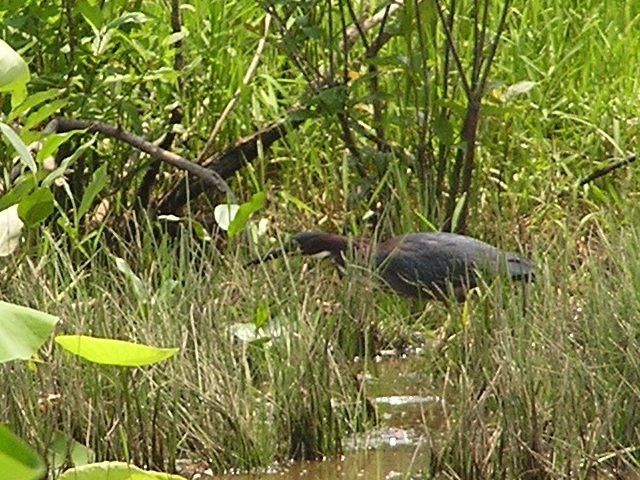 We all got a good look at a Green Heron feeding in a marsh near the headwaters of Lake Monroe. The marsh was heron paradice; we saw tons of Great Blue Herons and two Great Egrets.

