Spring Peeper
This spring peeper was translucent with the back light.

Last Saturday I joined the botany team for their monthly foray into the backcountry area of Morgan Monroe. It is fun to learn new plants, refresh old ones, and spend time with other botanists.
 |
| Downy Skullcap (Scutellaria incana) |
 |
| Great Indian Plantain (Arnoglossum muehlenbergii) |
 |
| Long-awned Woodgrass (Brachyelytrum erectum) |
 |
| Starry Catchfly (Silene stellata) |
 |
| Pretty Sedge (Carex woodii) is rhizomatous with a purple base. |
 | ||||
Bosc's Panicgrass (Dichanthelium bosci) had a downward pointing beard at the nodes.
|
 |
| Carex virescens had fuzzy perigynia and a long spike. |
 |
| Carex virescens had a fuzzy sheath. |
 |
| Pinesap (Monotropa hypopithys) |
 |
| Heart-leaf Hedgenettle (Stachys cordata) |
 |
| Sanicula trifoliata (Large-fruited Blacksnakeroot) was trifoliate, with large, bristly fruit. |
 |
| Swan's Sedge (Carex swanii) has fuzzy perigynia and short spikes. |
 |
| Goldenseal (Hydrastis canadensis) had bright red berries. |
 |
| Spring Peeper (Pseudacris crucifer) |
Kelly took Kirk and I out to see his research area at Eglin. We went a little before sunset to get some birding in, and then stayed to see what we could find in the marshes after dark. The birding was glorious in the day, but the night was magical. Chuck-wills-widows and Barred Owls were calling, in addition to all the frogs.
 |
| Two-toed Amphiuma (Amphiuma means) |
 |
| Two-toed Amphiuma (Amphiuma means) |
 |
| Eastern Mudsnake (Farancia abacura abacura) |
 |
| Eastern Mudsnake (Farancia abacura abacura) |
 |
| Eastern Mudsnake (Farancia abacura abacura) |
 |
| Eastern Mudsnake (Farancia abacura abacura) |
 |
| Northern Cottonmouth (Agkistrodon piscivorus) |

Ambystoma texanum
I found this mole salamander in the sandy soil of an emergent wetland in Terre Haute, Indiana. I was glad I hadn't hurt him while digging, and felt lucky to get to see him. After taking some pictures, I let him dig back into the sand. It is nice to think that spring isn't too far off.

This weekend was the Kankakee Sands BioBlitz 2012 in Newton County, Indiana. It was a wonderful opportunity to see the land, learn about the flora, and spend time with other biologists. The weather was good, sunny with a breeze; the ticks and other pests weren't too bad, and tons of flowers were blooming. I didn't take near as many pictures of some of the amazing flowers as I should have, but I spent a lot of time taking notes and trying to absorb it all. Of course, I did not force myself to stay focused on only plants.


 I was digging a soil pit on the edge of an agricultural field near Crawfordsville, IN, when this Western Chorus Frog caught my eye. I thought it was interesting to see it outside of breeding season.
 I run across Spring Peepers quite regularly while walking in the woods, but I less frequently see Wood Frogs. This Wood Frog was near beautiful wooded wetland in south central Michigan.
 This Gray Treefrog seems to be transitioning from green to gray. Maybe that is the color it wanted to be. It would have been fun to observe to see if it was changing and in which direction.
 A Gray Treefrog rests on a Boneset leaf.
 This full Garter Snake was relaxing on an island in the Kalamazoo River.
 This large (~5')snake was out on a warm October day on reclaimed mine land near Terre Haute. I didn't get a great look at it before it disappeared, but I am pretty sure it was a Black Rat Snake*.
*Much thanks to Kelly for his identification of this Racer. I stared at pictures for a while without coming to anything definitive. It was quite a large Racer.
Either Northern Redback Salamanders (Plethodon cinereus) are relatively common, or I find them frequently. I found five or six of these guys at Spring Mill underneath logs. I am pretty sure that the salamanders that aren't the red-backed morph are still Plethodon cinereus, but any suggestions are appreciated.


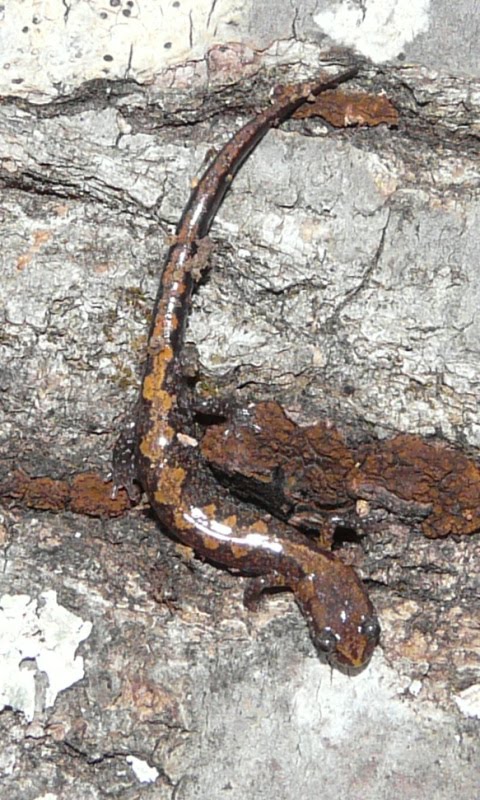
I was so excited to find some salamanders after a long winter while we were at Spring Mill. This lungless salamander (Plethodon dorsalis) had a very pretty pattern.