Showing posts with label Grouse. Show all posts

Saturday, April 05, 2014

Greater Prairie Chicken Lek

Kirk and I visited Prairie Ridge State Natural Area in Newton, Illinois. It was a pretty early morning, since we wanted to be there at least a half an hour before sunrise. Weather and conditions favored us; the wind was not bitter and the birds showed up. Almost as soon as we got to the northwest corner of the yard at the office, we began hearing an unearthly sound in the distance. Books describe the Greater Prairie Chicken's call as blowing across a coke bottle. I guess that is the best description, but it doesn't do the sound justice. Soon we began to make out the prairie chickens on the lek about 300 yards away. Two of them were hooting it up. Soon they started whooping. The naturalist who was watching with us mentioned that the whoops meant that there were female prairie chickens nearby. Sure enough, we spotted first one female, and then four more. The males began dancing in earnest, with fancy footwork and fluttery jumps into the air. The one male kept the other away from the females, and posturing and battles ensued. It was fun to watch this action. Soon, another male and another female showed up. It turns out that at least one of the males was a recently released bird that was captured in Kansas. The naturalist was happy to see him mixing it up with the locals so soon. They have been restocking with Kansas birds because the weather has taken its toll on the Illinois population, especially with an untimely hail storm last year. Eventually the females flew off to the north, leaving the guys with no one to impress. They eventually stopped performing and flew off after seventy-five minutes of strutting.

Who wants to see those crisp photos that are everywhere these days, when you could have photos that look like impressionist art? Did I mention that the lek was 300 yards away in low light?

Anyway, I was happy to capture some pictures that at least I could make out as prairie chickens. Here are the two first males side by side strutting their stuff.

One of the males walking along the top of the lek. The state discs the lek every year to keep the vegetation low.

I don't think I got any pictures of the females. They were clear enough to see in the scope, but they blended right in at that distance and light to my camera. For such large birds, they did a good job of hiding.

Two of the males doing battle.  It was a fun trip out to south-central Illinois to see these cool birds.  It is less than three hours from Indy and easy to get to.

Thursday, May 12, 2011

Great Basin Birds part 2

Yellow Warbler
For being a fairly common warbler, I have had bad luck photographing these attractive guys. They were the first warbler I remember identifying as a kid. This guy paused for an instant to check me out from the willows along Pruess Lake, south of Garrison, UT.

Blue-gray Gnatcatcher
Here is another common Indiana bird in an different setting. Their little buzzy calls mean spring to me.

Dark-eyed Junco
This Gray-headed Dark-eyed Junco was along the scenic drive up Mount Wheeler.

Loggerhead Shrike
It is a pleasure to get to regularly see shrikes around the valley. There are at least several pairs. This one is sitting with the Fortification Range in the background.

Sage Grouse
We visited the lek again, this time finding sixteen birds. There were at least 12 males displaying, and we counted 16 birds total when several of the groups flushed. The lek seemed to have spread a bit to the east, or maybe leks become more diffuse as the season goes along.

One of the groups flushing from the lek. They do not allow a close approach.

Wednesday, March 30, 2011

Great Basin Wildlife

We visited the Cleve Creek lek again. Seven males and three females this time. We could act hear them this time. They kind of sounded like racquetballs bouncing.


This Say's Phoebe was sitting on the visitors center roof. He either had a nest up under the eaves, or was thinking about building one. This is an attractive western phoebe.

This Pronghorn was staring off into the sunset outside in the Snake Valley.

Whenever we go through the Connors Pass early in the morning or later in the evening, we usually see the elk herd. Not actually at the pass, but in the valley right near the pass.

This adult male Northern Harrier flew right along side of us while we were driving on US50. He was cruising at 20 mph, and still could stop on a dime to dive for prey.

Thursday, March 24, 2011

Greater Sage Grouse Lek

Wednesday morning, we accompanied a BLM biologist to check on a couple Sage Grouse leks. Leks are a gathering place for males to display together to try and attract females. Here is a video of illustrating their behavior on the lek.


We arrived at the Cleve Creek lek shortly before sunrise. Nine males were gathered and displaying. Three females were in attendance.

We saw a large herd of elk when we were driving up in the pre-dawn light, plus the frequent Pronghorn. Mule Deer are also around, but we have not seen any yet.

We really couldn't hear the Sage Grouse displaying. The wind was blowing away, and it was cold enough that we didn't feel like taking off our hats.

The second lek that we visited didn't have any grouse. They could have moved the lek nearby, or they might not have been there that morning. It was a smaller lek, averaging three males.

View of the moon over the mountains from the lek.

Wednesday, June 09, 2010

Alpine Tundra

Joy looking out from an overlook along Trail Ridge Road. Tuesday, we drove from Grand Lake to Fort Collins via Trail Ridge Road through Rocky Mountain National Park. It was still too early for wild flowers, since there was a lot of snow cover in places. It was, though, a great time to look for alpine tundra birds.

The trail from the Alpine Visitors Center to Milner Pass.

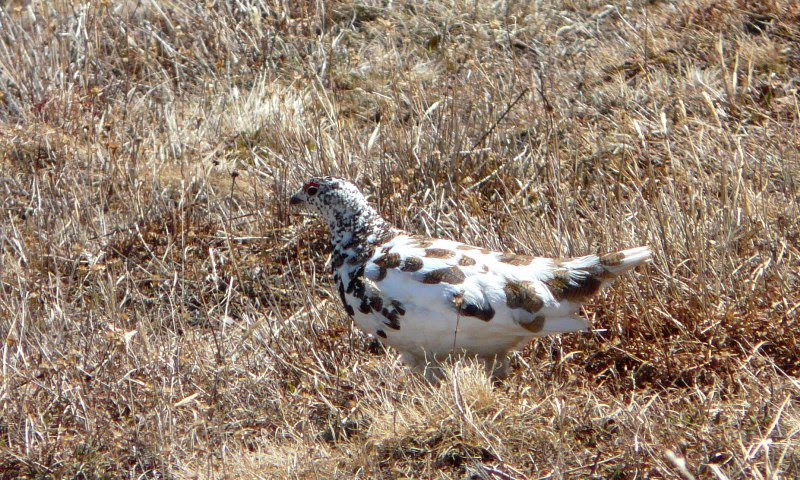
White-tailed Ptarmigan was one of my target birds. These guys made it easy, walking right across the path.

Ptarmigan strikes a pose

You can see how well the Ptarmigans can blend in. I took a wide angle shot of this bird, and I couldn't even find him in the photo.

American Pipits seemed to be the most common tundra bird, along with Horned Larks, and White-crowned Sparrows.

Brown-capped Rosy Finch was the other alpine tundra species that I was really hoping for. They made it pretty sporting, and I only saw several.

I hear that they are almost always on the snow fields, but only one of the ones I saw was near a snow field. BTW, it is almost impossible to take a good, detailed photo of something dark on a snow field on a sunny day.

This Rosy Finch landed beside the car while I was waiting in a considerable line for road construction. It might be the first time that I cursed the luck that the workers got the traffic moving too quickly. I had no choice but to leave these life birds behind...

Sunday, August 12, 2007

Monday, August 01, 2005

Canadian Birds


I (Ben) had to put up a bird picture from our trip to Canada. It was quite a treat to get to see some boreal (northern) species, though there are still many more that I did not get to see. One of the highlights was finding a Spruce Grouse, or Fool Hen as it is sometimes known, in a spruce bog in Algonquin. He was quite tame, as indicated by the name of Fool Hen. Other cool birds seen were a pair of Merlins, three American Bitterns, and lots of Common Loons.