Friday, April 30, 2010

Eastern Hognose Snake

Yesterday, I was lucky enough to come across an Eastern Hognose Snake (Heterodon platirhinos) while walking along a ridge just north of Bloomington, IN. He puffed right up for us, and was delightfully cooperative.


I love this section from Amphibians and Reptiles of Indiana by Sherman A. Minton Jr.

'When I first began hunting snakes near New Albany, the "Spreading Viper" was almost universally regarded as more dangerous than the Copperhead. There were not a few persons who believed the snakes could spit or spray venom. Today many people are aware of the harmless nature of this snake and even regard it with amusement. Recent recognition that it is indeed slightly venomous is a final bit of irony.'

After getting some close pictures, we let him continue about his way in pursuit of toads, frogs, and salamanders.

Heather got this picture of me checking out the Hognose. He certainly wasn't feeling aggressive.

Thursday, April 29, 2010

Hyla

I found this guy sleeping fat and happy in a wetland in Monroe County. It is either an Eastern Gray Treefrog (Hyla versicolor) or a Cope's Gray Treefrog (Hyla chrysoscelis). He looks like he is smiling to me.

Here is where he was sitting. He blends in pretty well. (He is in the center of the picture.)

Sunday, April 25, 2010

Rat Weights

We weighed the boys this week to see how big they have gotten. I thought for sure that Boone would be over two pounds. I was also surprised how much of a gap there was between Boone and Smoky, and that Scout was so close to Smoky. We always think of Boone and Smoky as the big boys, and Scout as the little guy.
Boone - 1lb 14oz
Smoky - 1lb 9oz
Scout - 1lb 6oz
I guess if we gave them equivalent weights in human terms, Boone would be 240lbs, Smoky would be 200lbs, and Scout would be 176lbs.
The rats have been very lovey lately, wanting to spend time on our laps. Above is a picture of Smoky enjoying being petted on Joy's lap. Usually they do not hold still for too long.

Monday, April 19, 2010

Pink Lady's Slipper - Cypripedium acaule

One of the floral highlights of hiking through the Red River Gorge this weekend was finding a patch of Pink Lady's Slipper or Pink Moccasin Flower in bloom. The specific epithet refers to the lack of a stem, with the flower coming right out of the basal leaves. This flower is interesting because it is a bog flower in northern Indiana, but in Kentucky it grows in dry, acidic woods. We saw several patches of basal leaves in open areas on ridge tops, but not blooming. This patch was sheltered and warmed by a rock face near the ridge top, most likely giving them a head start.

Wednesday, April 14, 2010

Florida/Alabama Herps

Hyla femoralis - Pine Woods Treefrog
I found this guy blending in with the lichens on the trunk of a locust tree in a swamp at Hillsborough River State Park, Florida.
Eurycea cf. quadridigitata - Seepage Bog Dwarf Salamander
This salamander was under the same log as the Rough Earth Snake Kelly and I found. Kelly went after the salamander and I caught the snake. I did not get as many pictures, since I was holding the snake at the time.

Lithobates clamitans clamitans - Bronze Frog
This ID is just a best guess. The spotting under the chin is interesting. He was sitting in a ditch/wetland along a highway in Flomaton, Alabama. (The name Flomaton always sounds like a bad infomercial product to me.)
Hyla cinerea - Green Treefrog
This was such a tiny treefrog, he was barely wider than the sedge leaf blade.
Coluber constrictor priapus - Southern Black Racer
The snake photo doesn't really fit with the other amphibians in this post, but I thought I would throw him in there and call it a herp post. Racers were the most common snake encountered while we were working. I was expecting to see this guy when I approached, and sure enough he was sitting in the grass sunbathing. He slithered off into the woods, but then decided to come back to his cover underneath this discarded roofing material, crawling right through my legs.
Eurycea cirrigera - Southern Two-lined Salamander
This sprightly salamander was in a creek bed in Gadsden County, Florida. He was very active and would even jump. I liked his posture.

Sunday, April 11, 2010

Grab Bag of Florida and Alabama Plants, Part 2

Rhododendron canescens - Mountain Azalea
I have gone back and forth about this azalea, and not having a guide or key available has made it more difficult. R. canescens is supposed to be fairly pubescent, as these are. They seem to match the description on Alabama Plants.
Helianthemum carolinianum - Carolina Frostweed
If anybody is familiar with this little member of the Cistaceae, please feel free to correct the ID. This was growing in the sandy, dry soil along a pipeline corridor in Gadsden County, Florida. Thanks, Scott, for the ID help.
Illicium floridanum - Florida Anise-tree
I posted a picture earlier from Torreya State Park, but that individual was from a native landscaping. I was very excited to see one growing wild on Friday and climbed down a Japanese Honeysuckle and Rubus covered him to see it up close. I did not realize yet that this shrub was blooming everywhere, filling the understory along wooded streams.
Clematis crispa - Swamp Leatherflower
This Clematis was blooming in a nice forested wetland seep in Gadsden County, Florida.
Iris verna - Dwarf Iris or Spring Iris
Similar to Iris cristata in stature, but lacking a beard of the sepals. This was blooming all over Little River State Park, Alabama.
Viola pedata - Birds-foot Violet
I almost overlooked this gorgeous violet at Little River State Park because it is almost the same color and height as the iris.
Drosera brevifolia - Dwarf Sundew
Blooming on a sandy, apparently dry hillside in Escambia County, Alabama. The relative proportion of the flower to the leaves is striking.

Polygala lutea - Orange Milkwort

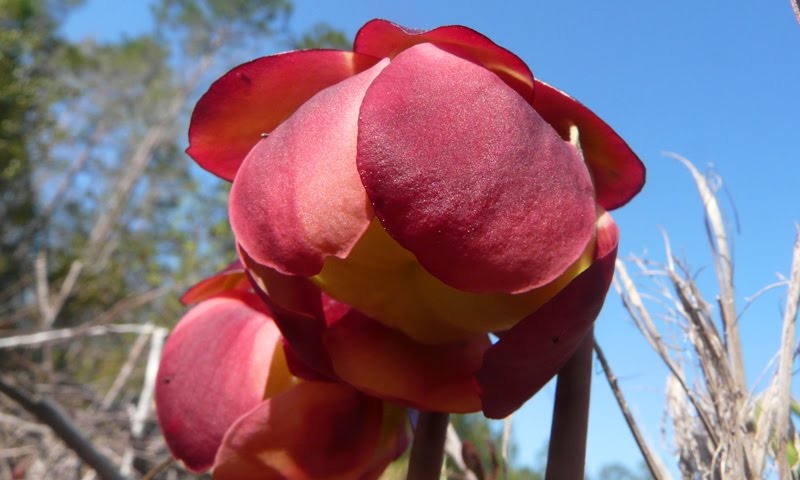
Sarracenia rubra - Sweet Pitcher Plant
Escambia County, Alabama

Friday, April 09, 2010

Cottonmouth!

Today I got some nice looks at a fearsome and impressive creature, Agkistrodon piscivorus. I had been expecting Cottonmouths in every wetland, swamp, and ditch I waded through, without seeing any. (They very well could have been there, sight unseen.) My respect for these creatures has not diminished, by any means, after seeing them up close.

This was the first Cottonmouth I came upon. I spotted him from a distance and got some nice pictures without disturbing him.
It had been a cool night, and he was still warming himself in the sun beside a wetland/pond. Here you can see him in a defensive posture with his head cocked back at a 45 degree angle. He even rattled his tail against some dead leaves to give warning.
If that warning was not threatening enough, here you can see him showing his nice and white cotton mouth. I don't know if the white in his mouth necessarily reminds me of cotton, but it does sound better than white-mouth or snow-mouth. Check out the fangs.
Here he is staring straight at me. At no point was I close, but he was certainly aware of our presence.
Here is the third Water Moccasin that I saw. He made me respect their camouflage ability. I walked right past him and did not see him until I looked back. He was not near the water, but was sitting up the hill further in the leaves under a bush.
Mark, my coworker, started towards me after I told him that there was a Water Moccasin. That was very good, because the snake started keying in on him, while he was a safe distance away (and I was much closer.)
This snake was feisty and must have been feeling threatened and ornery. He shook his tail hard and made violent movements as if he were going to dart toward us.
Pretty soon, he took to the water, but it was clear he was not retreating or conceding the fight. He swam with his head up out of the water, and then turned back towards the shore and glared a challenge at us. What a beautiful and terrible creature.
Thursday, April 08, 2010

More Florida/Alabama Lizards

Here is a collection of lizards that I have encountered while working in Florida and Alabama, in addition to the ophisaur. The lizards sure have been out-numbering the snakes in species and individuals. Several lizards on this trip have gotten away without being captured in a photo, like the race runner and broad-headed skink.

Anolis sagrei - Brown Anole
This is one of the non-native reptiles in Florida. They are from Cuba and the Bahamas. This one was near Tampa.
Scincella lateralis - Ground Skink
These seem to be fairly common. I found this individual at Torreya State Park. More often than not, I'd just hear them scurrying off through the dry leaves.

Hemidactylus - Gecko
This may be a Hemidactylus turcicus, a Mediterranean house gecko. Kelly found this guy while we were going to church. There is nothing like a visit with the Easter Gecko! We put the gecko on the tree trunk to get a picture, and I was amazed at how well he blended in. We almost couldn't find him after he scurried around the trunk.
Anolis carolinensis - Green Anole
This Green Anole was in a pine woods that had recently been burned at Kelley State Park in Alabama. I was trying to get a picture of him on the black bark. I don't know why he decided to display for me. Maybe he was trying to say that he wasn't afraid of someone as slow as me.
Same picture, but I liked the colors in the close-up. Click on it and blow it up to full-size. The yellow on the labials is pretty cool.
Sceloporus undulatus - Eastern Fence Lizard
This individual seemed especially vibrant. He had quite a good set up on a hollow log that allowed for a rapid retreat. A pretty common lizard, but I love seeing them. They remind me of the thrill of the chase I would get as boy whenever I spied one.

Wednesday, April 07, 2010

Ophisaurus ventralis - Eastern Glass Lizard

While walking the pipeline corridor in Santa Rosa County, Florida, Mark spotted this gorgeous Ophiosaur. I very gently picked him up, since I did not want to injure him in any way. To keep him from struggling, I cradled him in my lap, where he quickly calmed down. Here you can see him looking out from under my shirt.
We estimated that he was 20 inches. I love his coloration, with the black background and colored checks. These lizards are gentle and should never be roughly handled.


The Ophisaur was somehow holding on to me. I lifted up my shirt and found out how!