Showing posts with label Alabama. Show all posts

Wednesday, April 14, 2010

Florida/Alabama Herps

Hyla femoralis - Pine Woods Treefrog
I found this guy blending in with the lichens on the trunk of a locust tree in a swamp at Hillsborough River State Park, Florida.
Eurycea cf. quadridigitata - Seepage Bog Dwarf Salamander
This salamander was under the same log as the Rough Earth Snake Kelly and I found. Kelly went after the salamander and I caught the snake. I did not get as many pictures, since I was holding the snake at the time.

Lithobates clamitans clamitans - Bronze Frog
This ID is just a best guess. The spotting under the chin is interesting. He was sitting in a ditch/wetland along a highway in Flomaton, Alabama. (The name Flomaton always sounds like a bad infomercial product to me.)
Hyla cinerea - Green Treefrog
This was such a tiny treefrog, he was barely wider than the sedge leaf blade.
Coluber constrictor priapus - Southern Black Racer
The snake photo doesn't really fit with the other amphibians in this post, but I thought I would throw him in there and call it a herp post. Racers were the most common snake encountered while we were working. I was expecting to see this guy when I approached, and sure enough he was sitting in the grass sunbathing. He slithered off into the woods, but then decided to come back to his cover underneath this discarded roofing material, crawling right through my legs.
Eurycea cirrigera - Southern Two-lined Salamander
This sprightly salamander was in a creek bed in Gadsden County, Florida. He was very active and would even jump. I liked his posture.

Sunday, April 11, 2010

Grab Bag of Florida and Alabama Plants, Part 2

Rhododendron canescens - Mountain Azalea
I have gone back and forth about this azalea, and not having a guide or key available has made it more difficult. R. canescens is supposed to be fairly pubescent, as these are. They seem to match the description on Alabama Plants.
Helianthemum carolinianum - Carolina Frostweed
If anybody is familiar with this little member of the Cistaceae, please feel free to correct the ID. This was growing in the sandy, dry soil along a pipeline corridor in Gadsden County, Florida. Thanks, Scott, for the ID help.
Illicium floridanum - Florida Anise-tree
I posted a picture earlier from Torreya State Park, but that individual was from a native landscaping. I was very excited to see one growing wild on Friday and climbed down a Japanese Honeysuckle and Rubus covered him to see it up close. I did not realize yet that this shrub was blooming everywhere, filling the understory along wooded streams.
Clematis crispa - Swamp Leatherflower
This Clematis was blooming in a nice forested wetland seep in Gadsden County, Florida.
Iris verna - Dwarf Iris or Spring Iris
Similar to Iris cristata in stature, but lacking a beard of the sepals. This was blooming all over Little River State Park, Alabama.
Viola pedata - Birds-foot Violet
I almost overlooked this gorgeous violet at Little River State Park because it is almost the same color and height as the iris.
Drosera brevifolia - Dwarf Sundew
Blooming on a sandy, apparently dry hillside in Escambia County, Alabama. The relative proportion of the flower to the leaves is striking.

Polygala lutea - Orange Milkwort

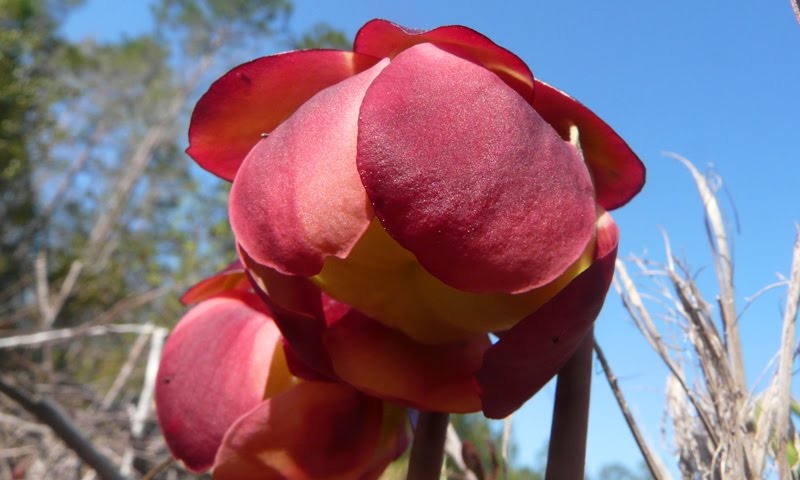
Sarracenia rubra - Sweet Pitcher Plant
Escambia County, Alabama

Thursday, April 08, 2010

More Florida/Alabama Lizards

Here is a collection of lizards that I have encountered while working in Florida and Alabama, in addition to the ophisaur. The lizards sure have been out-numbering the snakes in species and individuals. Several lizards on this trip have gotten away without being captured in a photo, like the race runner and broad-headed skink.

Anolis sagrei - Brown Anole
This is one of the non-native reptiles in Florida. They are from Cuba and the Bahamas. This one was near Tampa.
Scincella lateralis - Ground Skink
These seem to be fairly common. I found this individual at Torreya State Park. More often than not, I'd just hear them scurrying off through the dry leaves.

Hemidactylus - Gecko
This may be a Hemidactylus turcicus, a Mediterranean house gecko. Kelly found this guy while we were going to church. There is nothing like a visit with the Easter Gecko! We put the gecko on the tree trunk to get a picture, and I was amazed at how well he blended in. We almost couldn't find him after he scurried around the trunk.
Anolis carolinensis - Green Anole
This Green Anole was in a pine woods that had recently been burned at Kelley State Park in Alabama. I was trying to get a picture of him on the black bark. I don't know why he decided to display for me. Maybe he was trying to say that he wasn't afraid of someone as slow as me.
Same picture, but I liked the colors in the close-up. Click on it and blow it up to full-size. The yellow on the labials is pretty cool.
Sceloporus undulatus - Eastern Fence Lizard
This individual seemed especially vibrant. He had quite a good set up on a hollow log that allowed for a rapid retreat. A pretty common lizard, but I love seeing them. They remind me of the thrill of the chase I would get as boy whenever I spied one.

Monday, April 05, 2010

Grab Bag of Florida and Alabama Plants

I haven't had time to sort through a lot of botany photos from the last week, since there is so much going on. It is fun to be in a new place and learning new things. If the lack of chronological order bothers you, maybe the alphabetical order will appease you.

I love the woody diversity in wetlands down here. Black Titi or Buckwheat Tree (Cliftonia monophylla) is in full bloom right now. It looks pretty similar to Cyrilla racemiflora or Swamp Titi, but Cliftonia lacks the obvious lateral veins on the underside of the leaves. I will have to keep my eyes open and add a Cyrilla photo when I find one.
Toothache Grass (Ctenium aromaticum) had very aesthetically pleasing spikes remaining from last years growth. These were at the seepage bog Kelly and I visited on the east side of Eglin.
There were several sundews (Drosera) at the seepage bog, but the one that really caught my eye was Drosera tracyi. Most sundews are pretty low to the ground with a basal rosette of leaves, but not this one. Carnivorous plants are very interesting to me.
Osmanthus americanus is also known as Wild Olive or Devilwood. It is a member of the Olive family, Oleaceae and has opposite leaves.
You can see the bow of my kayak in the bottom of the picture. I tied up to the tree in a swift current on the Blackwater River to get some pictures.
As we were hurrying back from the seepage bogs on Saturday, I off-handedly asked Kelly when Pieris blooms, because we were passing a park that I knew had a nice Cypress swamp. Kelly proceeded to do a U-turn, and we jogged along the trail looking for some Pieris. Pieris is an Ericaceous plant that grows up inside the bark of Cypress trees, and sends out shoots that flower. I don't believe that they hurt the Cypress at all. Dinner was a little late, but I was glad I got to see this plant.
One of the interesting carnivorous plants at the seepage bogs we visited was a Butterwort (Pinguicula planifolia). Butterworts are in the same family as Bladderworts (Utriculaceae) and both catch prey. Butterworts do so with their sticky leaves.
Here is the flower of the same Pinguicula above. The notched petals and the subtle violet color made for an attractive flower.
There were two Polygalas blooming near the seepage bog. This is Polygala nana. Polygala lutea was also blooming. There are 13 reported Polygala species in Walton County alone.
I was not sure whether this Azalea was Rhododendron periclymenoides or canescens. It was blooming near a little spring on a hillside in Baldwin County, Alabama.
I visited Torreya State Park on my way to Atmore, Alabama last Tuesday. The park is on the Appalachicola River and has several rare plants. One is the Florida Yew. Kelly helped me find them.
Florida Yew (Taxus floridana) has a very restricted range and does not grow many other locations.
The state park takes its name from the Torreya tree. This tree grows almost nowhere else.
The specific epithet of Torreya taxifolia refers to the similarity of the leaves to the Florida Yew. Torreya leaves are more spiny.
This Trillium was blooming at Torreya State Park. I was not sure whether it is T. lancifolium or T. underwoodii. I am putting my money on T. underwoodii, since the leaves do not look very lance-shaped.
This little Bladderwort (Utricularia subulata) was growing in the seepage bog on Eglin. I am not sure how the bladders would work if the plant is rooted in the ground.
This Atamasca Lily (Zephyranthes atamasca) was blooming in the floodplain at Torreya State Park. Quite an attractive flower.

Wednesday, March 31, 2010

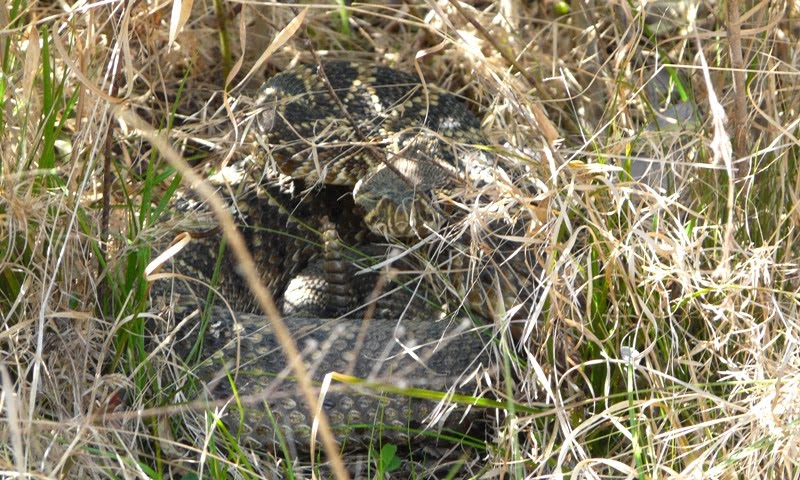
Eastern Diamondback (Crotalus adamanteus)

I was very excited today to see my first Eastern Diamondback Rattlesnake. We were working in backwoods Baldwin County, Alabama. As I was looking at a wetland when I heard something move behind me. The rattler moved up under a bush and coiled into a defensive posture. The Diamondback is relatively rare, so I feel pretty lucky to get to see one up close. It was fun walking through brush after seeing one of the local residents.